We built Whisq for two reasons.
One of us couldn't cook his mother's food. The other couldn't decide what to cook tonight. We built Whisq to solve both.
Almost everyone we know wants to cook more than they actually do.
Not in a someday, New Year's resolution kind of way. In a real way. They have the ingredients. They mostly have the time. They have, in many cases, an excessive number of pans. But somewhere between I should really cook tonight and let's just order something, the cooking quietly doesn't happen.
The two of us — partners in life, now partners in this — are squarely in that group. We like food. We have opinions about food. We grew up around people who cooked beautifully, and we'd like to be those people too. And yet most nights, we're also the ones staring into a fridge with a phone in our hand.
So we started asking why. Why do people who genuinely want to cook still end up not cooking?
The answer, it turns out, isn't one thing. It's a whole stack of small frictions sitting between you and dinner, and almost none of them have anything to do with the cooking itself.
The two essays below tell that story from two sides of the same kitchen.
A lifetime doesn't fit in a Notes app
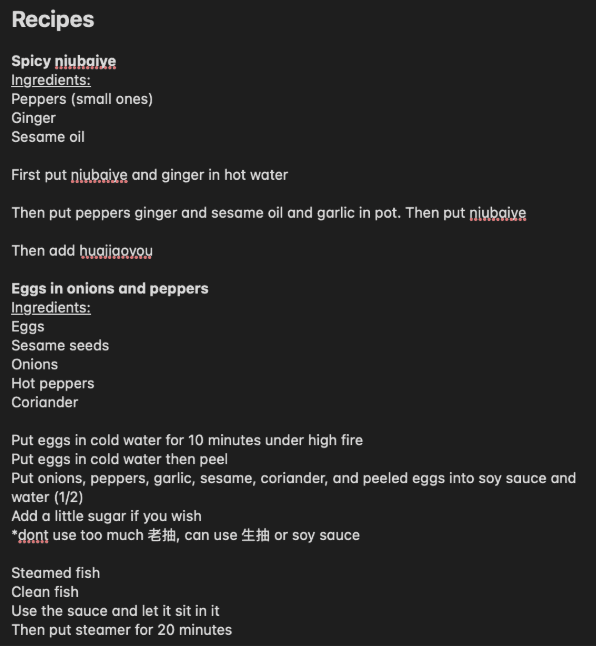
This is a note I wrote to myself four years ago. I was frantically typing ingredients and steps into my phone while my mom moved in a flurry, tossing aromatics into oil, narrating in Chinese I could half follow. COVID had sent me home from college. Eating Chinese food out every day wasn't realistic, and I figured: now's as good a time as any to learn.
What I found was that cooking is hard. You need the right ingredients, the right tools, the right timing. What sounds like five steps is actually a million. My Chinese is basically kindergarten-level and I can read maybe 10% of what my mom sends me. Learning from her directly was next to impossible.
It didn't help that I'd spent most of my life trying not to learn this. Growing up, I took her food for granted. I was an Asian kid with immigrant parents in a town that was 99% white. I remember opening my lunch and pulling out a tea egg (茶葉蛋), marbled brown from steeping in soy sauce and tea. The kid next to me reacted immediately with "that smells horrible". I never brought food from home again.
It wasn't until eighth grade when I moved to Taiwan that I saw, for the first time, everyone around me proudly eating the food my mom made. Tea eggs were in every 7-Eleven. The food I'd hidden at lunch was the food an entire country was built on. I came home with a completely different mindset.
So when COVID sent me back years later and I watched my mom cook for hours, I saw it differently. She'd braise tripe for three full days. I'd take a batch home in portions, freeze them, and a single batch would last me a month. I can still smell it. Taiwanese restaurants are rare where I live, so not being able to cook her food meant not really being able to eat it either. Her food is home, and without being able to make it, home felt out of reach.
There's exactly one dish of hers I can reliably make. Canto steamed chicken. Chicken legs in a bowl, ginger, red dates, steam for thirty minutes. Green onion and peppers on top at the end, then pour hot oil over to release the aromatics. Three steps, the right pan, five walkthroughs to make it stick. It's the only one I can cook without calling her.
Then there's cold-dressed tripe (涼拌牛百葉), the recipe at the top of this page. Five steps. Blanch the tripe, peppers in oil, mix, done. Hers is delicious. Somehow mine tastes ten times less flavorful with a questionable texture. To this day I don't know what I do wrong. The instructions themselves are right, they just aren't enough. A lifetime of cooking doesn't fit in a Notes app.
So we built Whisq. It takes whatever my mom sends — a YouTube link, a TikTok, a blog, a photo of her handwriting — and turns it into a recipe I can actually make. Structured steps, ingredients split out per step, and the video is still there when I need to see the visual aid.
It won't make me as good as her. Nothing will. But the next time she sends me a recipe, I'll get further than the note at the top of this page.
It's on the App Store. Built for anyone whose best recipes are in a language they don't fully speak.
Joyce's version of the same story starts in the refrigerator.
My fridge has become a hostile work environment
There are a lot of decisions I make in a day.
Some of them matter. Some of them absolutely do not. But somehow they all arrive with the same urgency.
Alongside a mentally demanding job, I have bills, ambitions, a social life I'm allegedly maintaining, hobbies I still refer to as if I actively do them, and only a finite number of usable thoughts per day. By the time I clock out, so have those thoughts.
And of course, that's also the exact time I have to decide what to make for dinner.
This is always offensive to me.
Not because cooking is bad. Cooking is lovely in theory. In theory, I come home, make something good, and feel restored by the process. In theory, I enjoy "using what I have on hand."
In reality, I open my fridge and it looks like a failed settlement colony.
There's half an onion. Eggs. A bag of spinach performing its final act. Greek yogurt bought for that one recipe a month ago now entering its fourth week of abandonment. Chicken I forgot to defrost. Or, on especially punishing days, chicken I did defrost, which is somehow worse, because now it has expectations.
Nobody tells you that a huge part of adulthood is having the same psychological standoff with your refrigerator every night.
Should I cook?
Do these ingredients make a meal or just a trail mix?
Can I afford to order in again?
Who are these prices for? Diplomats? Minor royals?
And that's the problem. The issue has never been that I need more recipes. The internet is full of recipes. The issue is that most of these recipes come from people claiming a meal is "so easy" before asking me to caramelize three separate things and locate a spice I would need to smuggle in from a hillside village.
What I needed was not more inspiration. I needed fewer decisions.
I needed a way to get from exhausted to fed without having to run a full internal strategy process first.
And that's why we built Whisq: to remove the mental friction from cooking at home; the part that has nothing to do with actual cooking and everything to do with deciding, planning, remembering, and improvising.
The Plan tab is for the version of me who has her life together. I can save recipes, plan meals for the week, and automatically turn them into a grocery list. Which means I can shop like a person with a plan, instead of roaming the store and buying ingredients based on vibes and false confidence.
Then there's the Tonight tab, which is for the version of me that actually exists at 7 p.m.
I put in what I already have in my fridge, filter by cuisine and mood preferences, and Whisq finds recipes that work with it. Recipes that truly get me, and give me smart substitutions because nine out of ten times, I won't have that random fresh herb.
It makes home cooking feel like an actual option again. It clears out all the low-grade decision fatigue standing between you and your defrosted chicken.
Because cooking at home shouldn't require elite planning skills, a perfectly stocked pantry, and the optimism of someone who has never been charged $19.99 for delivery before tip.
The bar for me was simple: make the better choice easier. Make dinner less of a project. Make home cooking feel like something a tired person can still win at.
That's Whisq.
The hard part of cooking at home usually isn't the cooking. It's everything that happens before the stove turns on — figuring out what to make, making sense of the recipe, working with whatever is actually in your fridge, and trusting that the effort will be worth it in the end.
That's the part Whisq handles. So the cooking — the part you actually wanted to do — becomes the part you actually get to do.
It's on the App Store. We hope you'll come cook with us.
Come
cook
with us.
Whisq translates the world's recipes into something you can cook from. The headnote is for you. The timers are for the wok.